Community-led Forest Technologies: A Smart Forests Final Report
“Smart” digital technologies are increasingly being deployed to manage, monitor, and transform forests across the globe in pursuit of environmental targets and ecosystem services. But how do these devices and infrastructures change social interactions with forests?
The Smart Forests research project has found that the growing use of technologies such as geospatial technologies, camera traps, ecoacoustic sensors, drones, fire technologies, communication networks, and AI, among many other emerging technologies, can have profound social, political, economic, and environmental impacts on forest communities. The Community-led Forest Technologies final report sheds new light on these hitherto understudied impacts of forest technologies.
We first published an interim version of this report in February 2025, drawing on our initial four case studies. We circulated the interim report to generate conversation across communities, policymakers, technologists, and researchers, including through a Forest Technologies Workshop held at Kew Gardens in May 2025. Based on these conversations and feedback, we then undertook our fifth and final case study on Rainforest Regeneration in Scotland. The final report incorporates workshop reflections and findings from our fifth case study along with our interim report materials.

Among the findings, the report reveals how digital technologies can cause shifts in environmental governance. Big Tech has become increasingly involved in environmental monitoring and management in recent years, from WhatsApp to deliver fire warnings to communities using geospatial tools for monitoring biodiversity.
The report outlines how digital technologies impact community ways of seeing and inhabiting forest worlds. Remote observation tools (such as those used to monitor carbon) can reinforce dominant views of forests and how they should be identified and valued. Likewise, species monitoring devices may better detect some species over others, leading to an inevitable prioritisation. Smart forest technologies’ distinct ways of seeing and sensing can obscure pluralistic, local and Indigenous understandings of forest processes if not carefully designed and deployed.
Moreover, the report suggests that uneven distribution of technologies and resources can create or perpetuate inequalities within and between communities. The report describes how, when only a select few forest communities are given the tools and assistance to identify and monitor illegal deforestation, logging can be displaced into surrounding forest areas where other communities lack access to the same technologies and resources.
The report further explores how digital technologies can alter or intensify existing power dynamics between states, technologists, NGOs and communities. Notably, wildlife monitoring devices, such as drones and camera traps, can operate as tools for state surveillance of forest communities. For example, in Uttarakhand, India, the state deploys digital devices to surveil and intimidate Van Gujjar communities, some of whom have been forcibly removed from their traditional lands. Conversely, these technologies can empower communities to make land rights claims.
These technologies can offer ways for communities to care for and protect their forest lands, as seen in Bujang Raba in Indonesia, where communities have been protecting diverse tropical rainforests through a carbon monitoring scheme. At the same time, these devices can convert forests primarily into carbon stores, rather than more complex social-cultural milieus.
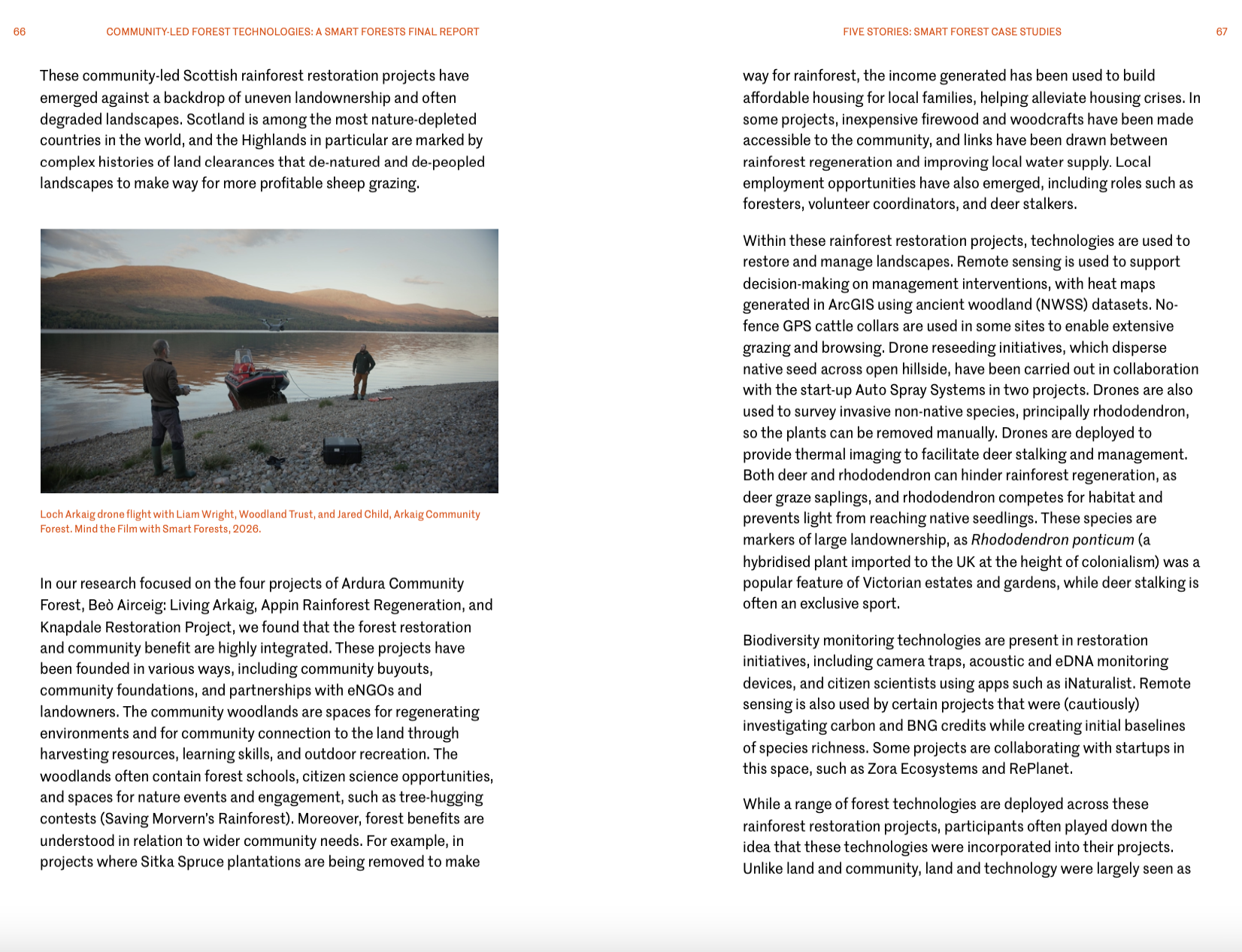
Community-led projects in Scotland pursue forest restoration as inextricably linked to community wellbeing. Community participation and integrated visions of rainforest and community life proved to be crucial to sustainable regeneration. Whereas open-access tools and platforms support community knowledge and imaginaries, remotely operated monitoring technologies can curtail local decision-making on landscape-scale change, disempowering rural populations.
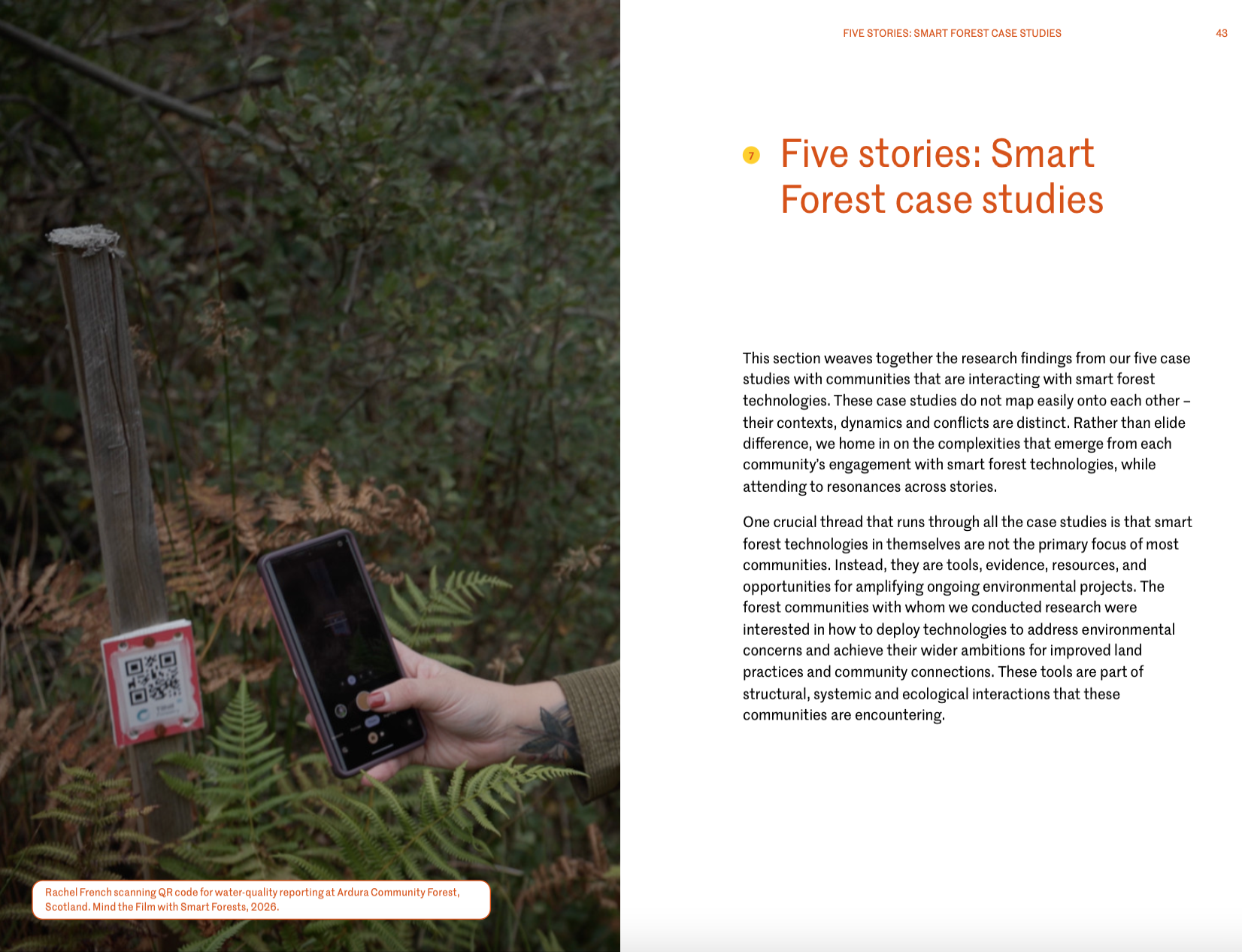
Crucially, forest technologies can help develop national and international forest networks; share culture, stories and education; and share information on topics such as ecology or fire prevention techniques. Digital forest technologies can also create livelihood opportunities and offer expanded ways to engage with forests.
After documenting and analysing the social and political impacts of forest technologies, the report draws together a series of proposals for how different approaches to digital and emerging technologies can create more just and thriving worlds. These strategies seek to ensure that diverse, community-led approaches to forest technologies can be effectively designed, implemented and supported.
The Smart Forests research project promotes engagement and discussion among communities, publics, policymakers, industries, and NGOs as users, regulators, funders, and developers of these devices and infrastructure. You can access the report and review the recommendations here.
This report has been created using a book generator designed and developed by Sarah Garcin. Full credits are available in the report.